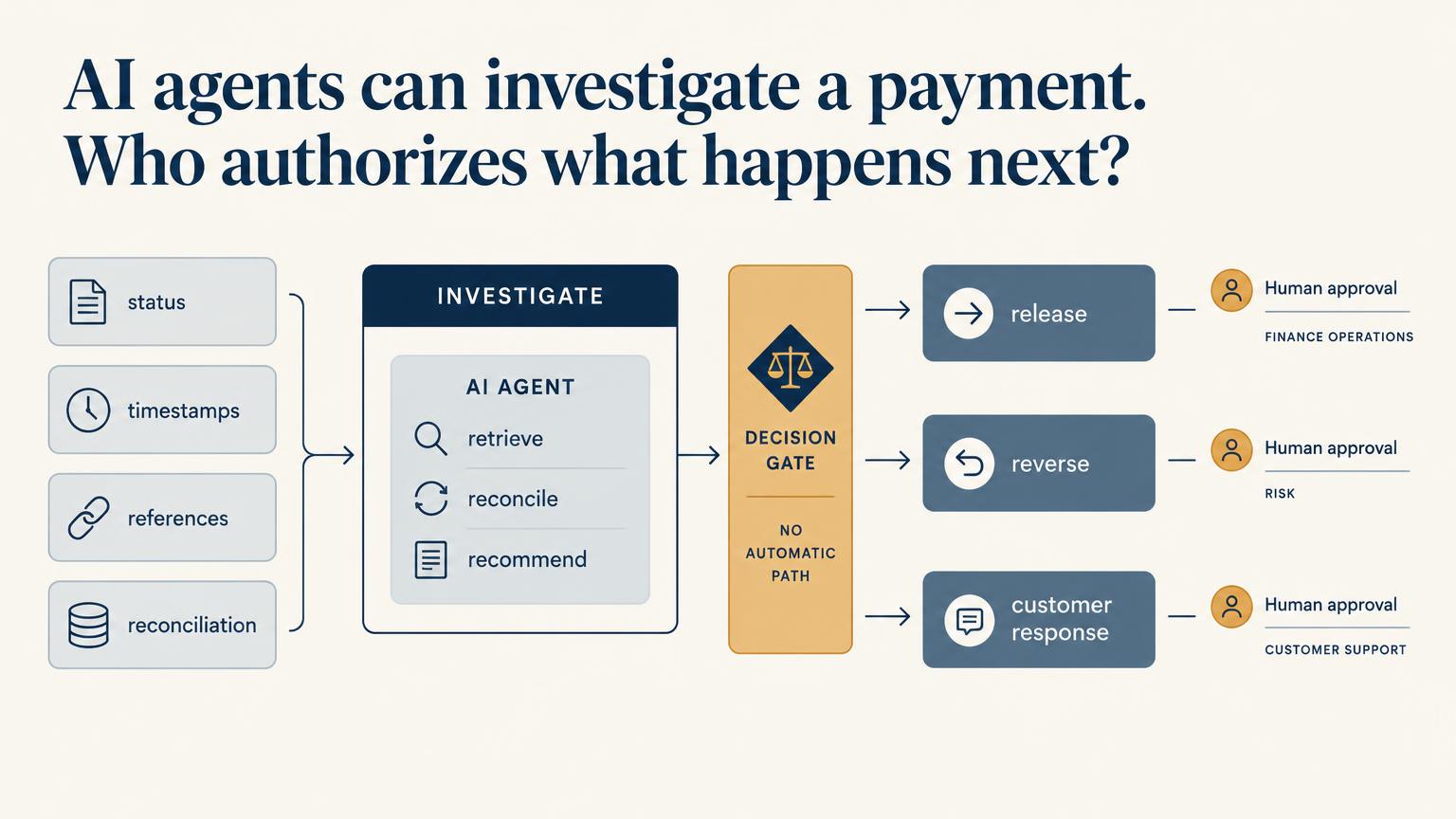
The useful opportunity is narrower than ‘agents moving money’
Form3 announced on 23 September 2026 that its new AI-enabled payments platform will allow authorised AI agents and people to retrieve and interpret payment information for operational investigation. The initial phase is a Model Context Protocol adaptor for the Form3 platform. Form3 says the adaptor is read-only, keeps the AI outside the payment flow and does not allow the agent to initiate changes.
That starting point is operationally important. Payment teams spend effort establishing what happened: which message arrived, which status changed, which reference identifies the transaction and which party owns the next step. Better retrieval and synthesis can make that work easier. But finding an answer across several systems does not itself confer authority to act on it.
That is why this is not another general argument for agentic commerce. The commercial issue here is exception handling inside an existing payments operation. The useful unit of change is the investigation workflow: the evidence assembled for an operator, the recommendation made, and the decision recorded. A firm can test that bounded role without assuming autonomous payment execution is either necessary or desirable.
- What Form3 announced: AI-enabled retrieval and interpretation of payment information for investigations.
- What the initial phase explicitly does not do: initiate payment changes or place the AI inside the payment flow.
- What operators can assess now: whether a bounded investigation role has a credible owner, control boundary and business case.
Where an investigation becomes a payment decision
Consider a customer asking why a payment has not arrived. An agent might gather the payment identifier, relevant status messages, timestamps, internal case notes and permitted reference data. It might highlight that the available records do not reconcile and draft a question for the receiving institution. Those activities help a human understand the case. They do not necessarily change the state of the payment or commit the firm to a customer outcome.
The boundary moves when the workflow proposes a consequential action: release a hold, retry a transaction, reverse an entry, amend a beneficiary detail, make a customer promise or close a complaint. Each can affect funds, liability, customer treatment or subsequent controls. Even an apparently administrative status change may be consequential if another system uses it to trigger a payment action. The right boundary is therefore defined by downstream effect, not by whether a tool is labelled ‘read-only’ or whether its screen looks operational.
A board should ask for a list of actions an agent can cause directly and indirectly. Can it write to a case record that another automated process trusts? Can it send a customer message without approval? Can it select a resolution code that releases a queue? Can it ask another agent to use a tool outside its own permissions? If those pathways exist, a nominal investigation assistant may already have operational authority. Tool access, workflow configuration and human sign-off must be reviewed together.
- Informational work: retrieve, compare, explain and identify missing evidence.
- Advisory work: recommend a next step with sources, uncertainty and an identified decision owner.
- Consequential work: change payment state, move or release funds, alter customer treatment or trigger a downstream action. Assign this to a controlled authorization path.
A five-gate framework for bounded payment agents
The first gate is identity and scope. Define the business purpose of the agent and the case types it may handle. Give it the minimum information access needed for those cases, using an identity that can be monitored and revoked. Separate retrieval permissions from any ability to update records. Where access to sensitive payment or customer information is involved, the design must follow the firm’s applicable access, privacy and retention requirements.
The second gate is evidence. An agent’s conclusion should point to the underlying records: source system, payment reference, timestamp and relevant status. Operators need to distinguish a retrieved fact from an inference and an inference from a recommendation. If records conflict or a source is unavailable, the case should show that gap rather than present a polished but unsupported answer. The objective is not a longer summary; it is a summary that a responsible reviewer can check.
The third gate is routing. Define, before deployment, which exception classes can receive an agent-prepared investigation and which require immediate specialist handling. Suspected fraud, sanctions concerns, disputed customer instructions and ambiguous beneficiary information are examples of categories to assess for separate treatment; the precise routing depends on the firm’s products and obligations. The agent should also have a reliable way to stop and escalate when the available evidence does not support a recommendation.
The fourth gate is authority. Name the role that can approve each consequential outcome and specify any second check required by the existing control environment. An approval should be tied to the exact proposed action and evidence available at that time, not to a broad instruction to ‘resolve the case’. If new information arrives, the action should be reconsidered. A human approval step is weak if the reviewer cannot see the sources, challenge the agent or realistically reject its recommendation.
The fifth gate is outcome and learning. Record what was approved, what actually happened in the payment and customer workflows, whether the case reopened and whether the initial explanation proved correct. Review recurring failure modes and update access, prompts, routing or policy accordingly. This closes the loop between a faster investigation and a genuinely better operation; speed alone is not evidence that the control model works.
- Gate 1 - Scope: Which cases and systems may the agent access?
- Gate 2 - Evidence: Can a reviewer verify each material conclusion?
- Gate 3 - Routing: When must the agent stop and escalate?
- Gate 4 - Authority: Which named role approves each consequential action?
- Gate 5 - Outcome: Can the firm reconstruct and learn from the final result?
Give every exception a decision owner
Payment exceptions rarely sit neatly inside one team. Payments operations may understand message flows and settlement states. Risk or financial-crime teams may own a separate restriction. Customer support may control what is said to the customer, while finance may need to reconcile the resulting position. Introducing an agent across those boundaries without naming decision rights can make a case look resolved in one queue while it remains open, or becomes worse, elsewhere.
A practical design starts with an exception register rather than a technology demonstration. For each common case type, document the initiating signal, systems of record, investigator, decision owner, approver where required, permitted actions, customer-communication owner and closure evidence. Mark which activities an agent may perform and which remain with a person or an established automated control. Where two teams have authority over different parts of the case, require an explicit handoff.
The escalation path deserves equal attention. A case should not become ownerless because the agent produces no confident answer, because two systems disagree or because the named approver is unavailable. Define a fallback queue, response expectation and way to preserve the case record. Equally, avoid an arrangement in which an agent repeatedly sends the same ambiguous case between teams. The operational test is whether a person can identify, at any point, who owns the next decision.
- Payments operations owns the payment-state investigation and its operational handoff.
- Risk or financial-crime owners decide matters within their mandates; an agent’s summary does not override a restriction.
- Customer-facing teams own approved communications and the record of what the customer was told.
- A named case owner remains accountable for coordination until the exception is closed and the outcome is verified.
Measure the case, not the demonstration
A polished investigation summary can be persuasive in a product demonstration. For an operating decision, the relevant question is whether it improves the end-to-end handling of eligible cases without increasing errors or weakening accountability. Establish a baseline before a pilot: case volumes by type, time spent finding evidence, time awaiting a decision, total time to verified resolution, reopens, corrections and the proportion of cases with a complete audit trail.
Then use a limited set of eligible exceptions and compare like with like. Measure whether investigators spend less time gathering records, whether approvers receive evidence they can actually use, and whether the customer receives an accurate outcome sooner. Track agent-specific failures: unsupported citations, incorrect record matches, missed escalation triggers and recommendations rejected by reviewers. A lower average handling time is not a success if complex cases are pushed into another queue or if corrections increase.
The board needs a balanced view: productivity, customer consequence and control quality. Report distributions as well as averages so difficult cases are visible. Record the scope of the test, the human effort still required and the circumstances in which the agent was disabled or bypassed. No performance gain is claimed here; these are proposed measures for determining whether a particular implementation earns wider use.
- Efficiency: investigator research time and total time to verified resolution.
- Quality: incorrect matches, reopens, corrections and customer-impacting errors.
- Control: evidence completeness, escalation accuracy and approval traceability.
- Adoption: eligible-case coverage and the amount of meaningful human review still required.
The Europe and GCC question is portability, not uniformity
European and GCC payment leaders may recognize a similar operational pattern: fragmented information, exceptions that cross teams and pressure to respond quickly. That similarity is a reason to examine a common control framework, not to assume common legal duties, schemes, data permissions or customer-remediation rules. This article makes no claim that Form3 launched the reported capability in the GCC or that any particular deployment has regulatory approval.
For a European institution, the design should be checked against the rules applicable to its activities, including requirements arising from its payment-services and operational-resilience obligations where relevant. EU legislation such as the revised Payment Services Directive and the Digital Operational Resilience Act provides primary reference points, but a URL to a regulation is not a legal assessment of a proposed workflow. Applicability, national implementation, supervisory expectations, outsourcing arrangements and contractual responsibilities need qualified review.
In the GCC, the same discipline applies jurisdiction by jurisdiction. An operator should establish which entity is providing the service, where information is accessed and retained, which local rules and scheme obligations apply, and who can authorize a customer-affecting payment action. Build a reusable operating pattern-scoped access, verifiable evidence, named authority and recorded outcomes-then adapt its permissions and approvals to each market. That is more credible than exporting a single policy label across regions.
- Reuse the control questions across markets; do not assume identical answers.
- Review data access, outsourcing, payment authorization and customer treatment for each entity and jurisdiction.
- Treat legal and regulatory review as part of workflow design, not as a sign-off added after a pilot.
The board decision: approve a bounded operating experiment
The decision in front of leadership is not whether AI agents are ‘allowed near payments’ in the abstract. It is whether a defined class of exceptions can be investigated with agent assistance under permissions and evidence standards that make the work safer to review. That is a narrower, more testable proposition than autonomous payments-and potentially a more useful place to begin.
Management can bring the board or its delegated committee a short proposal: the exception classes in scope, prohibited actions, source systems, accountable owners, approval route, escalation conditions, pilot measures and stop criteria. The proposal should explain how an investigator checks an agent’s cited evidence and how the firm will detect when an apparently informational output triggers a consequential downstream action. It should also state what must be true before scope expands.
The commercial case should remain conditional. If the pilot reduces research effort and improves resolution without degrading accuracy, customer outcomes or auditability, expand by case type and permission level. If it does not, adjust or stop. The governing principle is straightforward: permission to investigate a payment is not permission to decide what happens to the money.
- Approve a specific case scope, not a general mandate for an agent.
- Require an action-by-action authority map and a tested escalation route.
- Expand only on evidence from verified outcomes, not compelling demonstrations.
Key takeaways
- An agent’s ability to retrieve and interpret payment information is distinct from authority to change payment state or customer outcomes.
- Design five gates before expanding access: scope, evidence, routing, authority and outcome.
- Assign a named owner to every exception and every consequential decision, including cross-team handoffs.
- Judge pilots on verified resolution, errors and auditability as well as time saved.
- Apply a reusable control pattern across Europe and the GCC, but assess obligations and permissions jurisdiction by jurisdiction.
- Form3's announced starting point is controlled, read-only access for investigation rather than autonomous payment execution.
Frequently asked questions
Should an AI agent be allowed to investigate a payment exception?
It may be a suitable bounded use when access is scoped, source evidence is visible, uncertainty is surfaced and a person owns the next decision. Suitability depends on the case type and the firm’s controls.
Does human approval automatically make an agent-controlled workflow safe?
No. The reviewer needs the underlying evidence, a specific proposed action, genuine authority to reject it and enough time to exercise judgment. Indirect effects-such as a case update triggering another system-also need review.
What should remain outside an initial investigation pilot?
The firm should explicitly prohibit unapproved actions that move or release funds, amend payment instructions or commit to a customer outcome. It should separately route sensitive or ambiguous cases under its established policies.
Which measures tell a board whether the pilot works?
Compare eligible cases on research time, time to verified resolution, errors, reopens, customer impact, escalation accuracy and evidence completeness. State the pilot scope and retain a baseline; do not infer success from a demonstration.
Does Form3's announcement give AI agents authority to move money?
No. Form3 says the initial MCP adaptor is read-only, keeps AI outside the payment flow and does not allow the agent to initiate changes. Any move toward consequential payment actions would require a separate authority and control design.
Sources and further reading
- Form3 Launches AI Agentic Payments InfrastructureForm3
- Banks warn AI shopping bots raise scam, fraud and data-privacy risksReuters
- Directive (EU) 2015/2366 on payment services in the internal marketEUR-Lex
- Regulation (EU) 2022/2554 on digital operational resilience for the financial sectorEUR-Lex
Sources support the external facts and frameworks referenced above. The operating interpretation and recommendations are Muhammad Haris Aslam's.