Distribution is a capital-allocation business disguised as a sales business
A distributor buys before it sells, holds inventory before demand is certain and often extends credit after delivery. Between those events sit supplier minimum orders, retailer listing requirements, promotional commitments, rebates, claims, returns and price protection. Each can change both the eventual margin and the time required to turn stock back into cash. Revenue is visible early; the full economics of a transaction may become clear much later.
This matters particularly to owners, CEOs, CFOs and commercial leaders of GCC distribution businesses and family-owned trading groups. The point is not that every group has the same systems or terms. It is that decisions about stock, customers and supplier agreements compete for the same finite cash. A purchase order that looks sensible against forecast demand may be a poor use of capital if existing stock can be reallocated, the proposed channel carries heavy deductions or the customer pays slowly.
The right executive question is therefore not simply, ‘What will sell?’ It is, ‘What should we buy, move, sell, collect, renegotiate or stop-given the cash at risk and the contribution we expect to realize?’ That question defines an AI operating model more useful than a collection of forecasting pilots.
Why the timing matters-and what the evidence does not prove
Recent enterprise announcements point toward AI being connected more closely to operational workflows. SAP’s September 16, 2026 announcement describes AI-supported spend analysis and recommendations linked to procurement workflows. Its September 22 announcement describes an AI Agent Hub for inventorying agents and mapping their capabilities to owners. Gartner’s September 16 discussion of warehouse AI includes optimization and semi-autonomous agents while stressing transparency and human oversight. These are signals about product direction and governance questions, not evidence that distributors have achieved particular cash-flow or margin results.
A September 9, 2026 Distribution Strategy Group survey of 233 North American wholesale distribution executives reported that 93% considered AI strategic and 16% reported deployment across multiple functions. Those are survey responses from North America, not a benchmark for GCC distributors. They do, however, frame a useful management distinction: believing AI matters is different from connecting decisions across functions.
None of these sources supplies a ready-made operating model for a GCC trading group. Platforms can help produce recommendations and route work. Management still has to specify commercial logic, reconcile data, assign authority and test whether decisions improve cash conversion and realized contribution.
The decision unit: cash committed to a SKU, customer and channel
Most distribution reporting separates sales, purchasing, inventory and receivables. The separation is understandable organizationally, but it makes a poor decision unit. One SKU sold to two customers can produce different outcomes after discounts, listing fees, trade marketing, returns, rebates, delivery costs and payment delays. Equally, the same order can be attractive when fulfilled from ageing stock and unattractive when it requires a fresh purchase at less favorable terms.
A practical decision record joins a SKU, supplier, customer or channel, territory, time period and contemplated action. It shows inventory on hand and in transit; demand and sell-through; expected purchase cost and supplier terms; agreed customer terms; attributable deductions; fulfillment and returns costs; receivables exposure; and the likely time until cash is recovered. It distinguishes booked values from estimates and flags what has not been reconciled.
That record supports a decision, not a false promise of perfect accounting. Shared warehouse costs may need allocation rules. Future claims may remain uncertain. Rebate eligibility may depend on thresholds that have not yet been met. An AI system should expose those assumptions and show how a recommendation changes when they change. ‘Estimated net-net contribution, subject to claims reconciliation’ is a better management statement than a precise-looking number with invisible exclusions.
- Ask of every proposed commitment: How much incremental cash is required, for how long, and what could reduce the expected return?
- Compare alternatives: purchase, reallocate existing stock, change the promotion, pursue collection, renegotiate terms or decline the opportunity.
- Record the owner of the decision and the evidence available when it was made.
Build one commercial loop, not six disconnected AI use cases
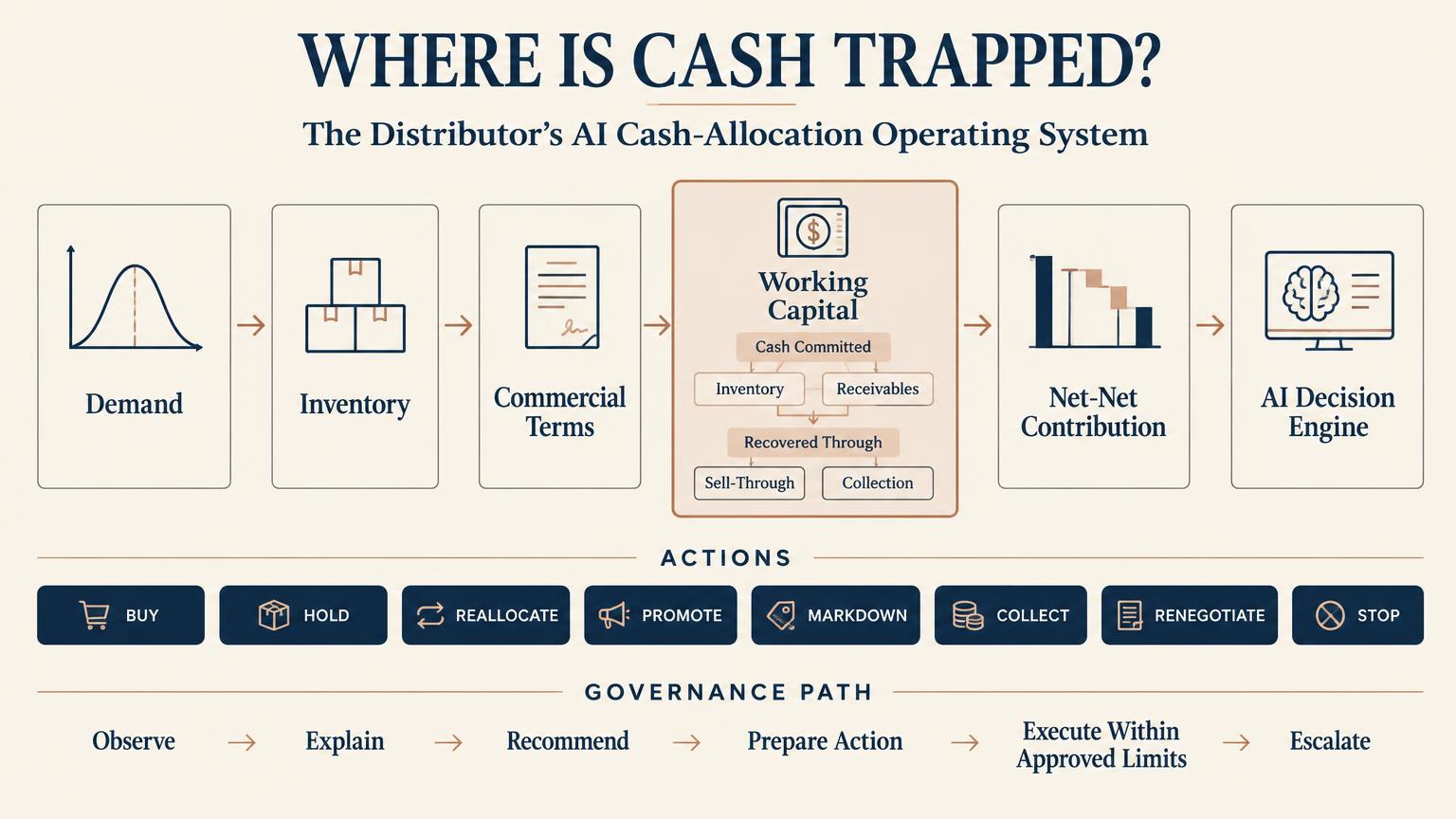
The proposed operating loop runs from demand through inventory, commercial terms, working capital and net-net contribution into an AI decision engine. Demand signals and SKU-level forecasts inform replenishment, but the engine must also predict stock-outs, overstock, ageing and potential dead stock. It should test allocation between retailers, marketplaces, stores and territories before recommending another supplier order.
Commercial terms belong inside the same loop. A supplier’s payment period, minimum order, rebate threshold and price-protection provisions alter the economics of buying. A retailer’s front margin, listing fee, promotional support, claims process and return rights alter the economics of selling. Credit limits and expected collection timing affect whether apparently profitable growth is financeable. If those inputs sit in PDFs, email or individual spreadsheets, the first job is to extract, verify and version them-not to let a model quietly guess.
The engine can then recommend supplier order quantities and purchase-order timing, channel reallocation, targeted sell-through activity, markdowns, collection priorities and agreements worth renegotiating. It can identify SKUs to increase, reduce or discontinue. Its recommendation should state the alternative considered, expected cash required or released, estimated contribution, principal risks and approval needed. The loop closes when actual sales, deductions, returns and collections are reconciled against that expectation.
Make the daily control tower answer seven executive questions
A Distributor AI Control Tower should be a decision queue, not a wall of charts. Its first view can rank exceptions by cash exposed, urgency and reversibility. An ageing SKU approaching a retailer return deadline may demand attention today; a modest forecast deviation may not. Every exception should link back to its underlying transaction, contract term and confidence level so a commercial leader can challenge it.
The queue should cross functional boundaries. Purchasing may see a replenishment opportunity while the CFO sees a receivables constraint; sales may see gross margin while finance sees unresolved backend deductions. Bringing those views together does not remove disagreement. It makes the trade-off explicit before another order or promotion commits cash.
Seven recurring questions give the control tower its discipline:
- Where is cash trapped today-in ageing stock, excess cover, overdue receivables, unresolved claims or avoidable new orders?
- Which inventory is likely to become a problem before routine reporting makes it obvious, and how certain is that assessment?
- Which SKUs should we buy more of, stop buying, reallocate between channels or move before ordering again?
- Which customers or channels look attractive on gross margin but weaken after deductions, returns, service costs and collection timing?
- Which supplier terms or retailer agreements warrant renegotiation, and what evidence would strengthen that negotiation?
- Where are rebates, trade spend, claims, returns, markdowns or price protection eroding estimated net-net contribution?
- Which response falls within an approved limit, and which requires commercial, CFO or CEO judgment?
Use six authority levels; do not confuse a recommendation with permission
AI should earn authority in stages. At Observe, it assembles data and detects exceptions. At Explain, it shows the underlying transactions, terms and assumptions. At Recommend, it compares feasible responses. At Prepare Action, it drafts a purchase order, transfer request, collection task or negotiation brief for review. At Execute Within Approved Limits, it acts only inside explicit boundaries. At Escalate, it sends material, uncertain or policy-breaking decisions to the accountable person.
Those levels are permissions, not a maturity slogan. A business may allow a low-value, reversible stock transfer between approved locations while requiring CFO approval for a credit-limit change and joint CFO-commercial approval for a major purchase. A retailer price commitment or supplier contract amendment may require senior executive or owner approval. The precise thresholds depend on the business; they should be documented before any autonomous workflow is enabled.
SAP’s September 22, 2026 agent-governance announcement highlights the practical need to know which agents exist and who owns their capabilities. That ownership must extend beyond IT. Each action needs a business owner, approved data sources, financial limit, exception route, audit trail and a way to suspend execution. If an agent cannot explain which contract version or cost assumption informed an action, it should prepare the decision for a person rather than execute it.
- Automatically observe and explain broadly; permit execution narrowly.
- Escalate low-confidence estimates, disputed deductions, unusual credit exposure and commitments outside policy.
- Log recommendations that humans reject as well as those they accept; both improve the decision process.
Reallocate before replenishing-and test the whole cash cycle
A common failure mode is to improve SKU forecasting while leaving purchasing logic unchanged. A demand signal in one territory triggers a new order even though another territory holds suitable stock. The first decision should be whether existing inventory can be moved in time and at a lower total cost. Availability, transfer time, shelf life, local demand, channel restrictions and supplier or retailer terms all matter. Reallocation is not always the answer; it is an alternative that should be tested before more cash is committed.
Likewise, a promotion that clears ageing stock can be rational even at a lower unit margin if it releases cash and limits future markdown or return exposure. But it should be evaluated after promotional fees, delivery, potential claims and any price-protection obligations. A proposed large order may appear to unlock a supplier rebate, yet lose value if the extra stock ages or consumes cash needed elsewhere.
The operating comparison is therefore broader than gross margin: incremental cash deployed; estimated net-net contribution; expected holding and collection periods; downside exposure; and operational feasibility. The control tower should show how a decision affects the cash-conversion cycle without implying that a single modeled number captures every contingency.
Make net-net contribution visible without pretending it is effortless
Net-net contribution is the commercial truth a distributor needs but may not be able to calculate perfectly on day one. Start with realized or expected revenue and product cost. Then identify customer discounts, rebates, listing fees, trade marketing, claims, returns, price protection, markdown support and attributable fulfillment or service costs. Show the timing of cash receipts and supplier payments alongside the margin estimate. Do not bury uncertain items inside an unexplained average.
Contract and deduction data need controls. Which supplier funds a promotion? Has a retailer claim been validated? Does a rebate apply to this SKU, period and customer? Who bears a return? A model can highlight mismatches and prepare a claim or negotiation file, but finance and commercial owners must settle the policy and the commercial relationship. This is especially important where agreements are amended informally or settlement occurs well after the initial sale.
The resulting view should allow leaders to distinguish a profitable customer with slow collection from an unprofitable customer with fast payment, and both from a relationship strategically worth serving on consciously approved terms. AI can make the trade-offs visible. It cannot decide the organization’s risk appetite or strategic obligations by itself.
A sensible implementation sequence starts with decisions, not software
Begin by choosing one recurring decision with a meaningful capital consequence: replenishment of a category, reallocation of ageing stock or resolution of customer-level deductions. Map how that decision is made today, who can approve it, which contracts govern it and where the necessary data resides. Establish a baseline using reconciled financial and operational records. If important terms are missing, improve capture and validation before scaling recommendations.
Next, run the AI layer in observation and explanation mode. Ask whether its exceptions are correct, timely and understandable. Introduce recommendations only after owners can inspect the assumptions and compare alternatives. Prepare actions in existing ERP, procurement, inventory and receivables workflows rather than creating an unaudited parallel process. Permit bounded execution only when error handling, permissions and rollback are tested.
Measure decision quality as well as model performance. Forecast error can improve while cash outcomes worsen. Review aged inventory and stock-outs together; estimated versus realized net-net contribution; claims recovered or resolved; overdue receivables; unnecessary purchases avoided; and the time between detecting an exception and deciding what to do. Interpret changes carefully: seasonality, supplier terms and commercial mix can move these measures independently of AI. A disciplined review asks whether the operating decision changed for a defensible reason.
- First 30 days: define the decision, data lineage, baseline and approval map.
- Next 30-60 days: shadow decisions, reconcile exceptions and test recommendations against actual alternatives.
- Only after control testing: prepare actions and authorize narrowly bounded execution with escalation.
What European brands should ask of a GCC distribution partner
For a European brand, the same framework offers a more useful partner conversation than asking whether a distributor ‘uses AI’. The commercial question is whether the partner can show how demand becomes an inventory commitment, how stock is allocated across channels, which deductions affect realized economics and how exceptions reach a decision-maker. Visibility need not mean access to the distributor’s confidential customer-level data. It does require agreed definitions and a credible method for reconciling stock, sell-through, claims and returns.
Brands should ask how price protection and promotional funding are governed, how ageing or excess stock is surfaced before it becomes a dispute, and who has authority to change replenishment or channel allocation. Distributors, in turn, should be clear about the information and supplier terms they need to make good decisions. Better joint visibility cannot compensate for an agreement that rewards volume while leaving one party with disproportionate stock risk.
The strongest relationship is not the one with the most dashboards. It is the one where both sides understand the economics of each major commitment, identify exceptions early and resolve them before they turn into stranded inventory or contested claims.
The board-level test: can management explain its next unit of cash?
An AI-native distributor is not a business in which agents make every purchasing, pricing and credit decision. It is a business in which management can see the likely consequences of those decisions across inventory, terms, contribution and cash-and act in time. The system should surface alternatives and prepare routine work. Human leaders should set policy, own material commitments and handle exceptions where commercial judgment matters.
A useful board or owner review can begin with five questions: What cash is currently committed to stock and customers whose economics are deteriorating? Which future commitments could be avoided by moving or selling existing stock? Which agreements obscure or dilute realized contribution? Where are collection and supplier-payment timing creating preventable pressure? Which AI actions are permitted, and who can stop or override them?
If those questions cannot be answered reliably, the priority is not to announce an autonomous distributor. It is to build the data, reconciliation and decision-rights foundation that makes better capital allocation possible. The objective is straightforward: buy more deliberately, release trapped cash sooner and know which growth actually contributes after the full commercial bill arrives.
Key takeaways
- Treat the cash committed to a SKU-customer-channel decision as the core operating unit, not forecast accuracy or gross margin alone.
- Connect demand, inventory, terms, credit and deductions before authorizing more purchasing.
- Test reallocation, collection and commercial renegotiation alongside replenishment and promotion.
- Use Observe → Explain → Recommend → Prepare Action → Execute Within Approved Limits → Escalate to preserve accountable decision rights.
- Label estimated net-net contribution honestly; reconcile claims, shared costs and collection assumptions before treating it as fact.
- Measure changed decisions and realized outcomes, not the number of AI agents or dashboards deployed.
Frequently asked questions
What is an AI cash-allocation operating system for a distributor?
It is a proposed decision framework connecting demand, inventory, supplier and retailer terms, receivables, and net-net contribution. Its purpose is to identify where cash is committed or trapped and recommend actions within explicit human-controlled decision rights; it is not a claim about an implemented product.
Why is AI demand forecasting not enough?
A forecast does not determine whether to buy, transfer existing stock, change a promotion, pursue a receivable or renegotiate terms. Those choices require an assessment of cash required, full commercial deductions, timing and risk.
What does net-net contribution mean here?
It means estimated or realized contribution after relevant product costs, commercial deductions and attributable service costs-not simply invoiced gross margin. The calculation should identify unresolved claims, uncertain rebates, shared-cost assumptions and collection timing rather than present an unreconciled estimate as exact.
Should an AI agent place purchase orders automatically?
Only if the organization has approved a narrow, tested limit with reliable data, a named owner, an audit trail and an exception route. Material or unusual purchases should be escalated to authorized people.
Where should a GCC distributor start?
Choose one recurring, capital-intensive decision; map its current approvals and data; establish a reconciled baseline; then test observation, explanation and recommendations before preparing or executing actions.
What should a European brand ask a GCC distribution partner?
Ask how the partner tracks stock and sell-through, allocates inventory, reconciles claims and returns, governs price protection and promotional funding, and escalates ageing-stock or replenishment decisions. Agree on useful visibility without assuming access to confidential underlying data.
Sources and further reading
- SAP Ariba Spend Analysis and Insights Now AvailableSAP News Center, September 16, 2026
- Autonomous Enterprise: Business Transformation Management Solutions and SAP AI Agents Work at ScaleSAP News Center, September 22, 2026
- Gartner Identifies the Top 4 AI Trends Transforming Warehousing for Supply Chain LeadersGartner Newsroom, September 16, 2026
- AI Top 25 Reveals a Wide Execution Gap Across Wholesale DistributionDistribution Strategy Group, September 9, 2026
- GCC Omnichannel Retail Operating ModelHaris Aslam
Sources support the external facts and frameworks referenced above. The operating interpretation and recommendations are Muhammad Haris Aslam's.