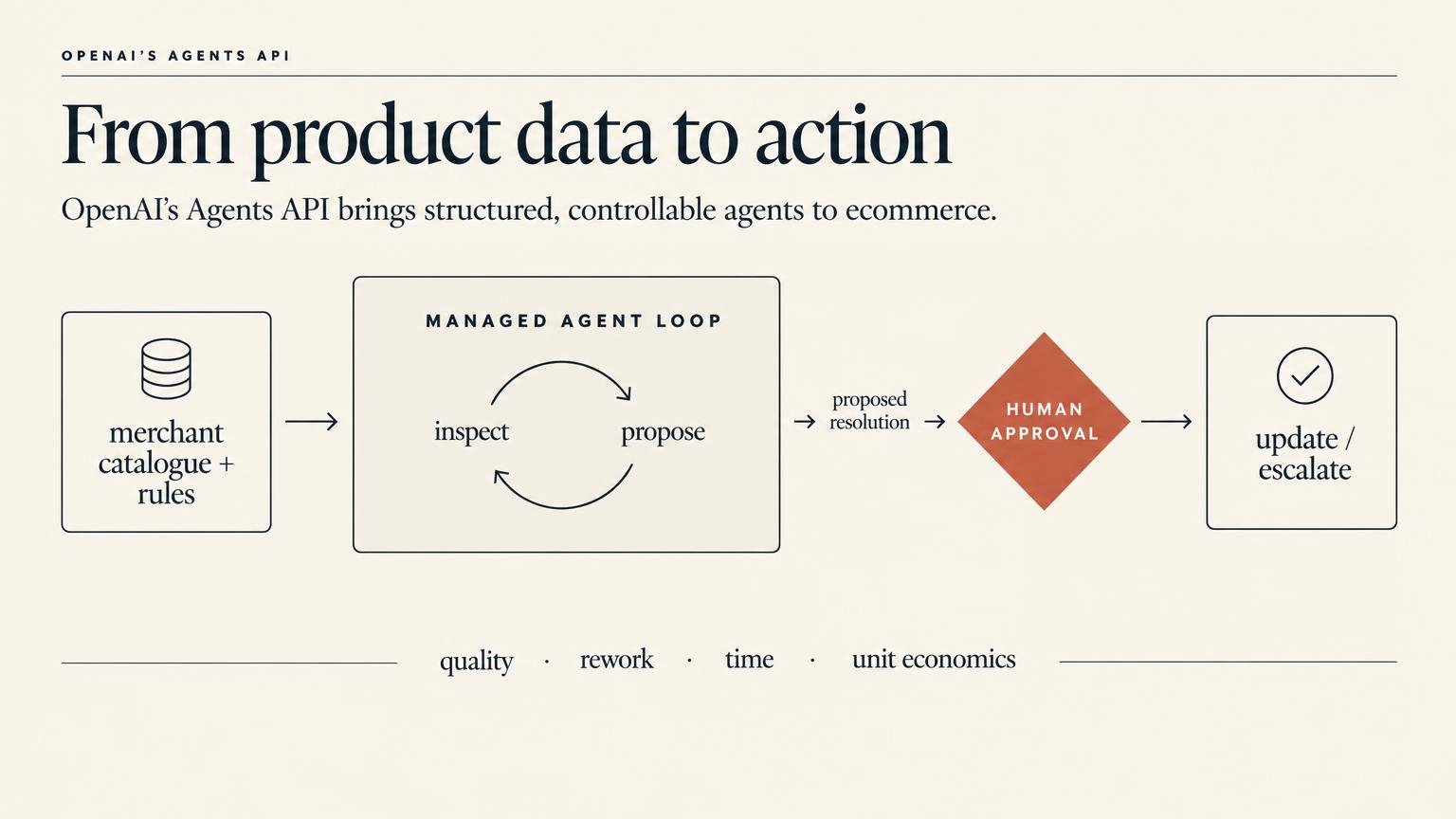
The announcement is infrastructure, not a merchant solution
On September 10, 2026, OpenAI introduced the Agents API in public beta and described cloud agents powered by a managed Codex harness [1]. That is a meaningful infrastructure announcement for teams building agent applications. It should not be recast as the launch of a standalone product called “Harness,” or as a ready-made ecommerce system. Neither description tells a merchant what business problem has been solved.
OpenAI’s architecture documentation describes the harness as the hosted agent loop and session layer. The application server remains responsible for product connections and tools [2]. In commercial terms, OpenAI can provide part of the machinery that runs an agent, while the merchant-or its implementation partner-must still decide which systems the agent may consult, what its tools may do, which decisions require approval and how results will be checked.
That division of responsibility is the starting point for an executive decision. A capable agent can still make a poor recommendation if catalogue records conflict, a policy is missing or its tool exposes the wrong action. Conversely, a tightly scoped workflow can be useful without granting the agent authority to change a product listing, issue a refund or contact a customer. The first board question is therefore not “How many agents can we deploy?” It is “Which supervised decision is costly enough to improve, and controlled enough to test?”
- What the announcement changes: the available infrastructure for building and running an agent application.
- What it does not supply: merchant data quality, operational policy, permissions, exception ownership or a proven ecommerce return.
- What to approve first: a bounded evaluation, not a general mandate for autonomous commerce operations.
Keep the Agents API separate from ChatGPT shopping
There is a second distinction worth making before budgets or roadmaps are discussed. OpenAI documents its Agentic Commerce Protocol separately as a way to connect merchants with ChatGPT shopping experiences [3]. That is a different commercial question from using the Agents API to build an internal agent-assisted workflow. One concerns a merchant connection to a shopping experience; the other concerns application infrastructure and the operational tools a business chooses to build around it.
A retailer may eventually evaluate both. It should not assume that implementing one provides the capabilities, access or results of the other. Product discovery, merchant product data, catalogue remediation and customer-service triage involve different owners, controls and success measures. Combining them into a single “AI commerce” programme before those distinctions are clear makes it harder to assign accountability.
For a CEO or digital-commerce leader, the practical separation is between a channel decision and an operating decision. If the priority is how products appear in a shopping experience, assess the relevant merchant-data requirements and channel economics. If the priority is reducing unresolved exceptions in an existing operation, assess the quality and safety of an internal workflow. The pilot below addresses the latter. It makes no claim about ChatGPT shopping access, availability or sales performance.
- Agents API evaluation: Can a merchant-built application help staff investigate and resolve a defined operational queue?
- Agentic Commerce Protocol evaluation: How should a merchant assess a separate connection to ChatGPT shopping experiences?
- Governance rule: Maintain separate owners, business cases and measures unless a specific dependency has been demonstrated.
Choose one queue: catalogue exceptions
A catalogue-exception queue is a useful candidate because the work can be described in observable steps. A product record may be held for review because required attributes are absent, a description conflicts with another approved source, or a localised listing appears inconsistent with the source catalogue. A member of the catalogue team has to identify the issue, consult relevant records and policies, recommend a correction or route the case to the right owner. Those actions can be evaluated without giving an agent permission to publish changes.
This is a proposed pilot design, not an OpenAI-provided ecommerce feature or a claim that a particular merchant has implemented it. The application would present an agent with an exception ID and a limited set of approved, read-only tools. The agent would retrieve relevant product data and policy material, state what it found, identify uncertainty and produce a structured recommendation. A human reviewer would accept, amend or reject that recommendation. Existing publishing controls would remain in place.
The scope matters more than the demonstration. “Help our catalogue team” is too broad to test. “Recommend a disposition for one class of incomplete product attributes in one catalogue queue” is specific enough to assign an owner and compare with current practice. The team can widen coverage later if the first queue produces reliable decisions. It should not begin with a mixture of catalogue updates, pricing changes, supplier outreach and customer communications simply because one agent could, in principle, be connected to all four.
- Define the input: one named exception type and the records required to investigate it.
- Define the output: a recommended disposition, supporting evidence, uncertainty and an escalation reason where needed.
- Define the boundary: no autonomous publication, pricing change, supplier instruction or customer message.
- Define the owner: a named operations team that can review decisions and maintain the underlying policy.
Build the pilot around five control gates
The most useful framework for this evaluation is a sequence of gates. Each gate answers a different question: Is the work suitable? Is the information dependable? Are actions constrained? Can people supervise the decision? Can the business measure whether the change is worthwhile? Passing a technical demonstration is not a substitute for passing those gates.
Gate one is workflow selection. Select a queue with recurring volume, a documented current process and decisions that can be reviewed after the fact. Exclude cases where the governing rule is still disputed or the consequences of a wrong recommendation cannot be contained. Write down the start and end of a case: what enters the queue, what a reviewer decides and what counts as resolved. Without that definition, an apparent reduction in handling time may simply move work to another team.
Gate two is evidence. For each recommendation, identify the authoritative source for product attributes, approved copy, market-specific requirements and any exception policy. Decide how the application will handle missing or conflicting records. A recommendation should cite the records it relied on within the merchant’s own environment; it should not turn a plausible guess into a source of truth. Test with deliberately incomplete records as well as straightforward cases.
Gate three is permission. Put merchant-controlled tools between the agent and business systems. In the initial pilot, those tools should retrieve only the data needed for the selected queue and should not expose write operations. If the use case later warrants a proposed edit, treat that as a separate design decision: specify what may change, who approves it, what is logged and how a mistake would be reversed. Do not rely on a prompt alone as the permission boundary.
Gate four is supervision. Give reviewers a short decision record: the proposed disposition, evidence consulted, outstanding uncertainty and the reason for escalation. Define when a case must stop-for example, when approved sources conflict or the recommendation would require an unauthorised action. Reviewers need a way to correct both the individual case and the policy or source-data issue that caused it.
Gate five is economics. Capture the full cost of the workflow, including model and infrastructure usage, integration maintenance, reviewer time, rework and monitoring. Compare that with a baseline for the same exception type. The question is not whether the agent can produce a convincing answer; it is whether the controlled process improves resolution quality or capacity at an acceptable cost.
- Workflow: one exception class with a clear beginning, end and accountable owner.
- Evidence: approved sources, conflict handling and a traceable recommendation.
- Permission: read-only retrieval first; consequential actions separately authorised.
- Supervision: explicit approval, escalation, correction and audit records.
- Economics: measured outcomes against the existing process, including human effort.
Measure decisions, not demonstrations
Before running the agent, sample cases from the current queue and record how they are handled. The baseline should use the same inclusion rules that will govern the pilot. Otherwise, the agent may appear faster because it receives easier cases, or appear cheaper because review and downstream correction are excluded. Where feasible, have reviewers assess recommendations against an agreed policy and final case outcome rather than judging whether the language sounds helpful.
A practical scorecard has five parts. Resolution quality asks whether the recommended disposition was supported by the approved evidence and whether the final action was correct. Rework asks how often a case had to be reopened or corrected. Service level asks how long cases spent waiting and whether the pilot displaced delay elsewhere. Reviewer effort asks how much human work remained, including time spent checking weak recommendations. Unit economics asks what a correctly resolved case cost when all pilot expenses are included.
Set the acceptance rules before seeing the results. A merchant might require that the pilot does not increase incorrect dispositions or rework, that it respects every permission boundary, and that any reduction in reviewer effort survives a full-cost calculation. Those are examples of decision rules, not claims about achievable performance. Record failures by type: missing source data, ambiguous policy, wrong retrieval, unsupported inference or inappropriate escalation. Each type points to a different remedy.
Also define a stopping rule. If reviewers cannot reliably tell why a recommendation was made, if sensitive information appears outside its intended workflow, or if the process repeatedly routes around human approval, pause the test and investigate. A pilot that reveals a data or control weakness can still be informative. Calling it a success because the agent completed cases quickly would not be.
- Baseline and pilot cases must use the same eligibility criteria.
- Report accepted recommendations alongside amended, rejected and escalated ones.
- Count downstream corrections and reviewer checks, not just agent runtime.
- Decide expansion only after quality, control and full-cost measures are reviewed together.
Design for GCC and European operating variation
A single catalogue workflow may encounter different languages, product conventions, fulfilment promises and internal approval paths across GCC and European operations. Those differences should be treated as design inputs, not as evidence that a platform has market-specific features or availability. The pilot owner should identify which differences affect the selected exception class before combining cases into one scorecard.
For example, a translated product title may require comparison with approved source copy, while a fulfilment-related attribute may depend on the specific market or seller record. The agent should not infer a local policy from another market’s example. Give it an approved source for the relevant context or require escalation. Reviewers should be able to see which market and language a recommendation concerns and which source governed it.
Governance deserves the same specificity. Decide where relevant data is stored and processed, who may access it, how long decision records are retained and what internal or external requirements apply to the chosen workflow. Legal, security and data-protection owners should validate those requirements for the organisation and market involved. An article cannot establish compliance for an individual merchant, and a general claim of “enterprise-ready AI” would not answer these operational questions.
A sensible first test may therefore use one market, language or product group-not because other markets are unsuitable, but because a smaller scope makes errors easier to identify. Expansion should require a fresh check of sources, policy, reviewer capability and economics. Reusing the same agent configuration across markets without checking those conditions is a deployment shortcut, not a strategy.
- Segment evaluation results by market, language and exception type where those factors change the decision.
- Escalate when the relevant local source or policy is absent or contradictory.
- Have the appropriate internal owners approve data handling and retention before live cases enter the pilot.
What the leadership team should authorise
A board or executive team does not need to select prompts or inspect every tool call. It does need to approve the business boundary. A useful pilot mandate names the queue, accountable executive, operational owner, technical owner and control reviewers. It states what information the application may access, what it may never do autonomously, how recommendations are approved and what evidence will support a decision to continue.
Fund the work in stages. First, map the queue and establish the baseline. Next, test the recommendation process against representative and difficult cases without changing production records. Only then consider limited use with live reviewers and the same approval boundary. At each stage, decide whether a failure comes from the agent, the tool connection, the source data or an unresolved business rule. Spending more on model usage will not repair an undefined catalogue policy.
The expansion decision should be explicit. If the first queue performs acceptably, the next step is not unrestricted write access. It may be a broader set of exceptions, an additional market or a tightly specified proposed-edit function-each with its own risk assessment and measures. If the evidence does not support expansion, retain the useful learning: which data needs repair, which policy needs an owner and which tasks should remain fully human-led.
The strategic opportunity is not to announce that the business has agents. It is to make a recurring decision process more dependable. OpenAI’s @OpenAI infrastructure announcement provides a reason to evaluate the tooling now [1][2]. The merchant’s competitive work remains the less visible part: reliable product information, disciplined permissions, capable reviewers and an honest account of whether the workflow improves.
- Approve one problem statement and one accountable owner.
- Require a baseline, an approval boundary and pre-agreed stop conditions.
- Review quality and total cost before authorising broader access.
- Treat any later automation as a new decision, not an automatic reward for a successful demonstration.
Key takeaways
- OpenAI’s Agents API public beta provides agent-building infrastructure; it is not a standalone ecommerce “Harness” product [1][2].
- A supervised catalogue-exception queue offers a more testable starting point than a broad automation programme.
- Merchant-controlled data sources, tools, permissions and approvals determine whether an agent recommendation is safe to use.
- Measure resolution quality, rework, service levels, reviewer effort and full cost against a comparable baseline.
- Keep the Agents API assessment separate from OpenAI’s Agentic Commerce Protocol and ChatGPT shopping evaluation [3].
- Discuss the announcement with attribution to @OpenAI where platform tagging is supported; relevant social-post topics include #AgenticAI, #Ecommerce and #AIGovernance. A tag does not imply endorsement.
Frequently asked questions
Did OpenAI launch an ecommerce product called Harness?
No. OpenAI described a managed Codex harness in its September 10, 2026 Agents API public-beta announcement. Its documentation describes the harness as a hosted agent loop and session layer, while the application server remains responsible for product connections and tools [1][2].
Can a merchant use the Agents API without giving an agent permission to edit its catalogue?
A merchant can design an application whose tools retrieve approved information and produce recommendations while existing staff retain approval and publishing authority. Those limits must be enforced in the merchant’s application and connected systems; they should not be assumed from the model or a prompt alone [2].
What is a suitable first ecommerce use case?
One recurring catalogue-exception class with approved source records, a documented resolution policy and a human reviewer is a candidate. The merchant should confirm that the queue is sufficiently consistent to evaluate and that mistakes can be contained.
How should the pilot be judged?
Compare eligible pilot cases with a baseline using resolution quality, rework, service levels, reviewer effort and full cost per correctly resolved case. Set acceptance and stopping rules before reviewing results.
Is this the same as joining ChatGPT shopping?
No. OpenAI documents the Agentic Commerce Protocol separately as a connection between merchants and ChatGPT shopping experiences. An internal agent-assisted operations pilot and a shopping-channel assessment need distinct business cases [3].
Can the same workflow be rolled out across GCC and European markets?
Potentially, but not by assumption. Check the sources, language needs, operational policies, data handling and approval paths for each proposed scope. Reassess quality and economics as the workflow expands.
Sources and further reading
- Introducing the Agents APIOpenAI
- Agents API: ArchitectureOpenAI Developers
- Agentic Commerce ProtocolOpenAI Developers
- AI & TransformationMuhammad Haris Aslam
Sources support the external facts and frameworks referenced above. The operating interpretation and recommendations are Muhammad Haris Aslam's.