The announcement is a reason to assess, not a reason to deploy
OpenAI introduced dots at DevDay on September 29, 2026, according to the Associated Press. OpenAI’s workspace guidance says dots features are rolling out gradually. It also says Enterprise workspace access is off by default and that connected apps have separate controls. Those are operational facts with immediate consequences: a merchant cannot plan a production workflow from a launch headline alone. Its own administrator must establish what is available in its workspace, who may use it and which connections, if any, can be enabled.
For a CEO, the question is narrower than ‘What can AI agents do for commerce?’ It is whether staff could use an assistant to assemble, check and explain operational material faster or more consistently while retaining the approvals that protect customers and the business. That question is worth asking now because the product announcement is new, not because demand or merchant outcomes have been demonstrated. The supplied search and analytics data predates the announcement and cannot establish interest in dots.
This is also a different decision from a general ecommerce-agent pilot. A broad pilot starts with categories of possible automation. A dots assessment should start with the actual workspace controls and a single task that an employee already performs. If access, permitted sources or review arrangements cannot be confirmed, the appropriate decision is to defer the test-not to substitute another product and call it a dots deployment.
- Confirm availability in the specific workspace before assigning an owner, budget or delivery date.
- Identify the administrator responsible for dots access and, separately, connected-app permissions.
- Write down the one operational decision the proposed assistant may help prepare; do not grant it that decision.
Keep dots separate from shopping, checkout and commerce protocols
Three different conversations are easy to collapse into one. A staff assistant may help an employee prepare or review work. A shopping experience helps a customer discover products. A commerce protocol addresses how commerce participants exchange information or carry out defined interactions. OpenAI documents its Agentic Commerce Protocol separately from dots. That separation matters when executives assess architecture: an announcement about an assistant is not evidence of a merchant checkout integration, a new storefront or an operational connection to a retailer’s systems.
Nor should leaders assume that an assistant can read their catalogue, order-management system, ERP or service platform. Whether information can be connected, what a connection exposes and what permissions apply are questions for the merchant’s workspace and technology teams to verify. A proposed workflow can still be evaluated using approved, deliberately supplied material if that is permitted. It should not be described internally as a live systems integration until one has been confirmed and governed.
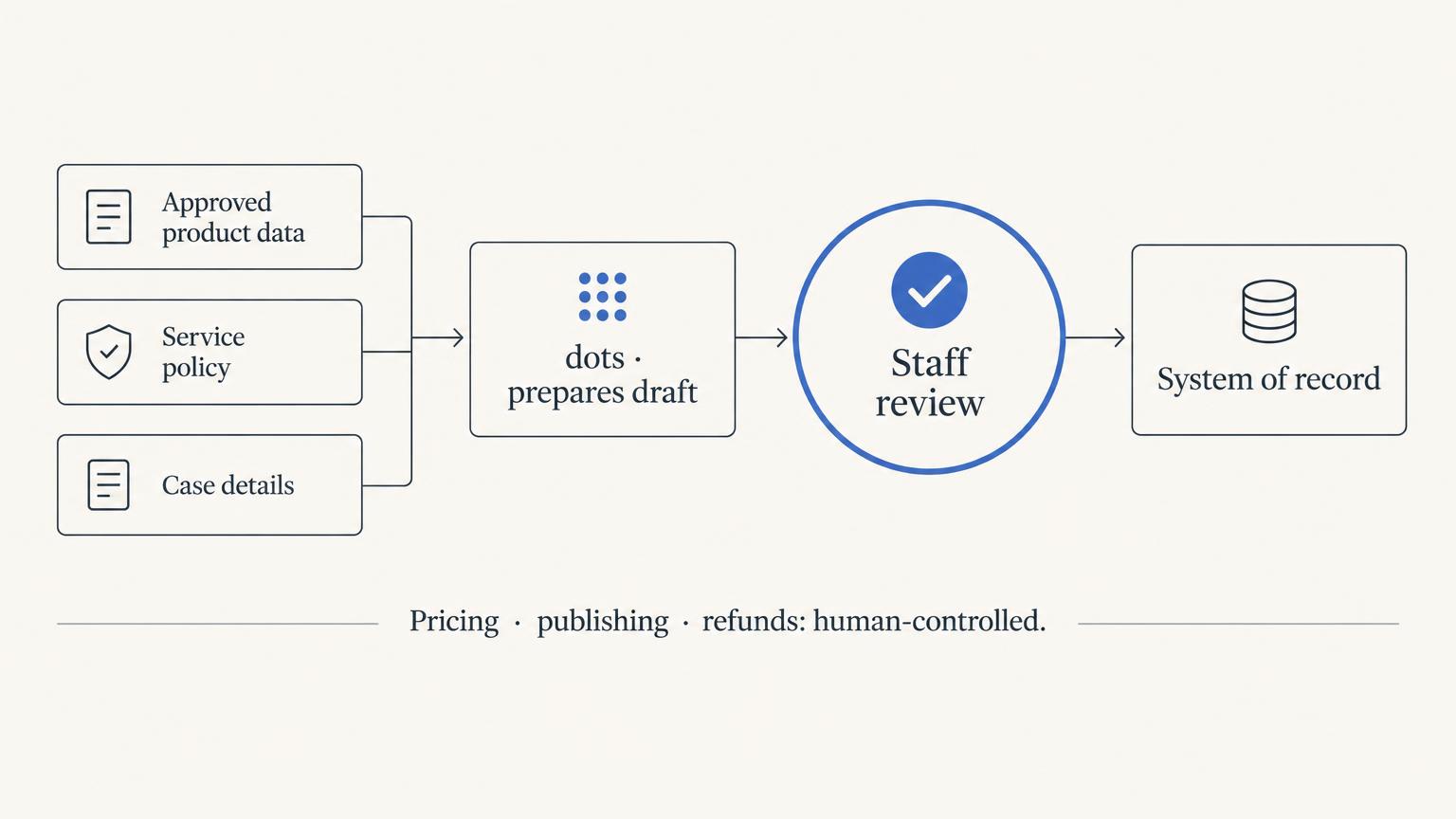
The distinction protects investment decisions as well as customers. If the business case depends on changing prices, publishing product content, issuing refunds or completing transactions without review, this is not a modest staff-assistance test. It is a much larger systems, controls and accountability programme. Start by separating preparation from execution. An assistant may draft an exception summary or suggest the evidence a reviewer needs; the existing authorised person and system should make and record the consequential decision.
- Staff assistance: prepare a reviewable draft from approved inputs.
- Commerce execution: change a record, make an offer, move money or communicate a binding decision.
- Customer experience: what a shopper can discover or do. Do not infer this from a staff-assistant announcement.
Choose one reversible case: preparing a catalogue exception
A useful first candidate is a catalogue exception that already requires human investigation. Imagine an employee receives a product record flagged because its title, attributes and category guidance do not agree. The proposed assistant’s job is to prepare a case file: restate the discrepancy, identify the supplied source for each relevant attribute, note missing evidence and draft a recommended question for the category owner. It does not decide the correct product claim or publish a corrected listing.
This is a proposed merchant workflow, not an announced dots capability or a proven result. Its appeal is operational. Catalogue teams often work across product submissions, approved taxonomy rules, existing content and market-specific review requirements. Preparing a concise case file is separable from authorising a change. If the draft is poor, the reviewer can discard it and complete the existing process. If access or permissible inputs are too limited to prepare a reliable case, the test can stop without changing the customer-facing catalogue.
Define the input boundary before anyone experiments. A controlled packet might contain the disputed record, the relevant approved taxonomy extract, a current internal policy excerpt and an assigned case identifier. Remove unnecessary personal or commercially sensitive data. Mark each document’s owner and version so the reviewer can tell whether a draft rests on current guidance. If approved information cannot be made available in the workspace under suitable permissions, do not compensate by pasting uncontrolled exports into a chat.
The output should be a review aid, not a polished answer that hides uncertainty. Require it to separate observed facts from proposed interpretation, identify the source for material claims, list unresolved questions and say when evidence is insufficient. The employee checks the underlying sources, records any correction and follows the existing publishing approval route. A second candidate, such as preparing a customer-service case, should wait: adding customer correspondence introduces different data and decision risks.
- Input: a deliberately scoped exception packet from approved sources.
- Output: a draft case file with cited evidence, gaps and a proposed next question.
- Authority: no direct publishing, price changes or edits to the product system of record.
- Reversal: discard the draft and use the current process whenever quality or permission is in doubt.
Use a five-gate test before the first live case
The first gate is access. Confirm whether dots is enabled for the relevant workspace and users, how access is administered and whether any connected app needed for the workflow is separately permitted. Because OpenAI describes a gradual rollout and Enterprise access as off by default, this is a check, not a planning assumption. Record the configuration the pilot actually uses; a test conducted with manually supplied documents should not later be reported as proof that an integration works.
The second gate is information. Name the approved source owner, permitted data classes, retention and handling requirements, and the person who can withdraw access. Review the proposed packet for supplier confidentiality, personal information, restricted product claims and obsolete guidance. The necessary privacy and contractual assessment will differ by company, market and source. The practical rule is to minimise inputs and establish a clear route for deleting or withdrawing material where the applicable setup allows it.
The third gate is authority. Document what the assistant may produce, what the reviewer must verify and which systems remain off limits. Customer-visible copy, prices, promotions, refunds and order decisions stay with authorised employees operating through established controls. Do not rely on a general instruction such as ‘be careful’ to define this boundary. Put the boundary in the workflow, permissions and review checklist.
The fourth gate is evaluation. Prepare a small set of representative cases, including straightforward records, conflicting evidence and cases where the correct response is ‘insufficient information’. Define how reviewers will record factual mistakes, unsupported claims, missing evidence and time spent checking. The fifth gate is ownership: appoint an operational sponsor, a process owner and a technical or security counterpart who can pause the test. If any gate fails, narrow the case or stop. A limited pilot is successful only if its limits are enforceable.
- Access: what is available, to whom, and under which workspace and app controls?
- Information: what approved material may enter, and who owns it?
- Authority: which outputs are drafts, and which actions remain approval-gated?
- Evaluation: what errors, rework and reviewer effort will be recorded?
- Ownership: who can approve, change or stop the test?
Measure the work around the draft, not just the speed of generation
A draft that appears quickly can still be expensive if an expert must reconstruct every claim. Establish a baseline from the existing catalogue-exception process: how a reviewer assembles evidence, which checks are mandatory and what constitutes a usable case file. Then compare assisted cases using the same standard. The relevant measure is not words generated per minute. It is the amount of trustworthy, review-ready work delivered for the total effort involved.
Track four dimensions together. First, quality: are material facts supported by the supplied sources, and are uncertainty and missing information visible? Second, rework: what must a reviewer correct, add or discard? Third, reviewer effort: how long does verification and approval take, including the time spent checking citations? Fourth, total cost: account for setup, administration, source preparation, training and ongoing review as well as product charges. None of these measures should be presented as a predicted saving before the merchant has observed its own process.
Add an exception measure: how often does the assistant produce a plausible but unsupported conclusion, overlook conflicting evidence or use information outside the approved packet? Such cases deserve more attention than a fluent draft deserves praise. Reviewers should be able to mark ‘not suitable for assistance’ without penalty. That signal may identify cases whose inputs are too ambiguous or whose decisions are too consequential for the proposed boundary.
Set an expansion rule in advance. Continue only if the draft meets the agreed quality standard, does not increase risk through hidden errors and reduces the combined preparation-and-review burden enough to justify its full cost. Otherwise adjust the source packet, narrow the task or end the test. Do not turn a preparation workflow into automated publishing merely because draft quality improves; that would require a separate control decision.
- Compare like-for-like cases against an observed manual baseline.
- Measure unsupported claims and missed conflicts, not only completion rates.
- Include reviewer time, administration and source maintenance in total cost.
- Treat any request for greater system authority as a new approval, not a routine pilot extension.
Apply market-by-market controls across the GCC and Europe
A group operating across the GCC and Europe should not assume one pilot configuration fits every market. Catalogue language, product-claim rules, supplier arrangements, privacy obligations and approval responsibilities may differ. A case packet suitable for one country may contain content that cannot be reused elsewhere, or a translation may lose a distinction that matters to the local category owner. Local operating leads should validate the sources and review checklist for their market before cases are added.
Availability also needs separate confirmation. The dots announcement and workspace guidance do not, by themselves, establish general availability in every GCC or European country, support for every working language or compatibility with a particular commerce stack. Make the access question explicit for each workspace and team rather than inferring regional readiness from a global announcement. If a local team cannot use the proposed setup, record that as a constraint rather than claiming a common regional rollout.
For cross-border groups, design a common control pattern but allow local inputs. The common pattern is approved source material, a bounded draft, visible evidence, a named reviewer and an existing route for publishing decisions. Local teams determine which policies and product facts are authoritative and who may sign off. This gives leadership comparable evaluation measures without pretending that a single prompt resolves distinct market obligations.
Data movement warrants its own check. Before using supplier files, service records or other restricted material, confirm the applicable internal policies, agreements and legal review requirements for that market and workspace configuration. This article cannot determine those requirements for a particular merchant. The operator’s responsibility is to identify them early enough that a convenient pilot does not establish an unapproved information practice.
- Verify workspace access and usable languages for each participating team.
- Assign local ownership of authoritative source material and review standards.
- Apply the group’s common approval boundary without assuming identical market rules.
- Resolve data-handling questions before sharing operational records.
Make the executive decision a limited mandate
The useful board or executive decision is not ‘adopt dots for ecommerce’. It is to authorise-or decline-a controlled assessment of one staff workflow. A sound mandate names the business owner, the operational problem, the allowed information, the prohibited actions and the evidence required to continue. It also makes clear that a product rollout, connected app or new feature may change what is feasible. The team should report what was actually tested, not what an announcement suggested might eventually be possible.
A catalogue-exception case is a candidate because the boundary can be made visible: prepare the file, verify the evidence, retain human sign-off and keep the product system of record unchanged by the assistant. That does not guarantee value. It creates a fair test of whether the assistant improves work that staff already need to do. If the reviewer has to redo the investigation, the sensible outcome may be to stop, improve the underlying product data or revisit the workflow design.
There is a commercial reason to be disciplined. An assistant that reduces preparation effort but increases checking, administration or error risk is not an improvement. Conversely, a narrow tool that makes uncertainty easier to see could be useful even if it never receives authority to act. The decision should turn on the merchant’s observed quality, reviewer effort, risk and total cost-not on whether the output resembles a capable employee in a demonstration.
For leaders considering a first assessment, the immediate next step is a readiness discussion between ecommerce operations, workspace administration and the relevant risk owners. Bring one real workflow, its current approval path and a sample of permissible source material. Leave with a go, narrow or defer decision. That conversation is more valuable than commissioning an autonomous-store roadmap before the available controls and operational case are understood.
- Authorise one bounded workflow, not a general mandate for autonomous commerce.
- Require a documented go, narrow or defer decision after access and information checks.
- Review observed quality and total effort before considering any expansion.
- Keep consequential actions within existing people, permissions and systems.
Key takeaways
- OpenAI’s dots announcement is timely, but gradual rollout and workspace controls make access verification the first step.
- Dots as a potential staff assistant should not be conflated with shopping, checkout or OpenAI’s separately documented Agentic Commerce Protocol.
- A catalogue-exception case file is a proposed, reversible first test-not a claimed dots integration or proven merchant outcome.
- Keep publishing, pricing, refunds and other customer-impacting decisions approval-gated.
- Judge the pilot on supported facts, rework, reviewer effort, exceptions and total cost, market by market.
Frequently asked questions
Can OpenAI dots run an ecommerce store or publish catalogue changes?
The supplied announcement and workspace guidance do not establish that it can. This article proposes a staff-assistance test in which dots may help prepare a draft if the required access and permitted inputs are available. Publishing and other consequential actions remain with authorised people and existing systems.
Is dots the same as OpenAI’s Agentic Commerce Protocol or a shopper checkout feature?
No. OpenAI documents the Agentic Commerce Protocol separately. A merchant should evaluate a staff-assistance workflow, a customer shopping experience and a commerce integration as distinct propositions, each with its own evidence and controls.
Is dots available to our teams in the GCC and Europe?
Do not infer availability from the announcement. OpenAI says features are rolling out gradually; its workspace guidance says Enterprise access is off by default and connected apps have separate controls. Ask your workspace administrator to confirm availability and permissions for each intended team and market.
What would justify expanding a first test?
Evidence from comparable cases that drafts reliably identify their sources and uncertainty, reduce combined preparation and reviewer effort, and justify their full cost without unacceptable exceptions. Expansion to a new workflow or any customer-impacting action should receive a separate permissions and approval review.
Sources and further reading
- Report on OpenAI’s dots announcement, September 29, 2026Associated Press
- Manage dots in ChatGPT workspacesOpenAI Help Center
- Agentic Commerce ProtocolOpenAI Developers
- OpenAI’s Agent Harness Is Not an Ecommerce StrategyHaris Aslam
Sources support the external facts and frameworks referenced above. The operating interpretation and recommendations are Muhammad Haris Aslam's.